ROUTLEDGE

A/B Testing
Backlog

Helping Routledge to a adopt test & learn ways of working.

ROUTLEDGE

A/B Testing
Backlog

Helping Routledge to research and build an A/B testing backlog to boost conversion.

ROUTLEDGE

A/B Testing
Backlog

Helping Routledge to research and build an A/B testing backlog to boost conversion.

ROUTLEDGE

ROUTLEDGE

A/B Testing
Backlog

A/B Testing
Backlog

A/B Testing
Backlog

A/B Testing
Backlog

Helping Routledge create an A/B testing backlog to boost conversions.

Helping Routledge create an A/B testing backlog to boost conversions.

Helping Routledge create an A/B testing backlog to boost conversions.

The brief

Routledge approached us with an 88% cart abandonment rate on their
e-commerce website and sought assistance in improving their conversion rate.

They asked us to gain customer insights, identify pain points, and create an A/B testing backlog to address these challenges.

Routledge approached us with an 88% cart abandonment rate on their
e-commerce website and sought assistance in improving their conversion rate.

They asked us to gain customer insights, identify pain points, and create an A/B testing backlog to address these challenges.

Routledge came to us because they had an 88% cart abandonment rate on their e-commerce website, and they wanted help with building an A/B testing backlog.

They asked us to gain customer insight, uncover pain points build an A/B testing backlog, and help lift their conversion rate.

Routledge approached us with an 88% cart abandonment rate on their e-commerce website and sought assistance in improving their conversion rate.

They asked us to gain customer insights, identify pain points, and create an A/B testing backlog to address these challenges.

The approach

Our first step was to align the business needs and set a clear project direction. To achieve this, we conducted a business discovery workshop, where we defined the project’s aims, potential success, and risks from the stakeholders’ perspective.

This process uncovered four key project pillars that guided our approach. Next, we shifted focus to understanding user needs by conducting interviews and usability testing with 15 participants representing our three personas.

Our first step was to align the business needs and set a clear project direction. To achieve this, we conducted a business discovery workshop, where we defined the project’s aims, potential success, and risks from the stakeholders’ perspective.

This process uncovered four key project pillars that guided our approach. Next, we shifted focus to understanding user needs by conducting interviews and usability testing with 15 participants representing our three personas.

Our first step was to align the business needs and set a clear project direction.
To achieve this, we conducted a business discovery workshop, where we defined the project’s aims, potential success, and risks from the stakeholders’ perspective.

This process uncovered four key project pillars that guided our approach. Next, we shifted focus to understanding user needs by conducting interviews and usability testing with 15 participants representing our three personas.

Our first step was to align the business needs and set a clear project direction. To achieve this, we conducted a business discovery workshop, where we defined the project’s aims, potential success, and risks from the stakeholders’ perspective.

This process uncovered four key project pillars that guided our approach.
Next, we shifted focus to understanding user needs by conducting interviews and usability testing with 15 participants representing our three personas.

My role

For this project, I led the UX and design strategy while managing stakeholder relationships. I developed a comprehensive testing plan and guided a team of four through to successful delivery.

Initial point of departure workshop.

Initial point of departure workshop.

Initial point of departure workshop project set-up.

Initial point of departure workshop project set-up.

Initial point of departure workshop project set-up.

Understanding the user's needs

We conducted an in-depth analysis of Google Analytics and Content Square data to examine key metrics and user journeys.

This revealed that most users were dropping off the site before reaching the checkout process.

To understand why, we ran usability tests focusing on Routledge’s three primary personas: Students, Professionals, and Faculty Teachers.

The Findings

We found that the reasons why users are dropping off were

due to:

• A lack of trust

• The website was clunky to use

• The search functionality wasn't behaving as expected

• The prices were too high to compared to Amazon's prices

• The cart page had too many distractions

• The delivery wasn't clear/good enough

We found that the reasons why users are dropping off were due to:

• A lack of trust

• The website was clunky
to use

• The search functionality
wasn't behaving as expected

• The prices were too high to
compared to Amazon's prices

• The cart page had too many
distractions

• The delivery wasn't
clear/good enough

We found that the reasons why users are dropping off were

due to:

• A lack of trust

• The website was clunky to use

• The search functionality wasn't
behaving as expected

• The prices were too high to compared
to Amazon's prices

• The cart page had too many
distractions

• The delivery wasn't clear/good
enough

Quantitative and qualitative research using google Analytics, content square and usability testing.

Quantitative and qualitative research.

Quantitative and qualitative research.

Research playback workshop

While presenting our research findings, we guided stakeholders in crafting ‘How Might We’ (HMW) questions to reframe problems into opportunities.

By grouping and theming these HMWs, we identified the areas with the most significant challenges. Stakeholders then voted on the areas they believed would deliver the greatest value as starting points.

Whilst presenting back our research results, we asked our stakeholders to write How Might We that rephrase problems into questions.


By theming and grouping the HMWs, it helped us see the areas with the most problems.
We then asked our stakeholders to vote on the areas that they thought would bring the most value to start with.

Prioritised HMW statements

Prioritised HMW statements

Ideation workshop

With a clear focus established, we sought inspiration from how others had tackled similar challenges. These examples served as a springboard for our ideation process.

Using simple Post-it notes, we brainstormed ideas, grouped and themed them, and used dot-voting to select the most promising concepts. We then refined these ideas further, turning them into actionable A/B testing experiments.

Ideation workshop inspiration board

Ideation workshop inspiration board

Ideation workshop inspiration board

Building the test experiments using hypothesis
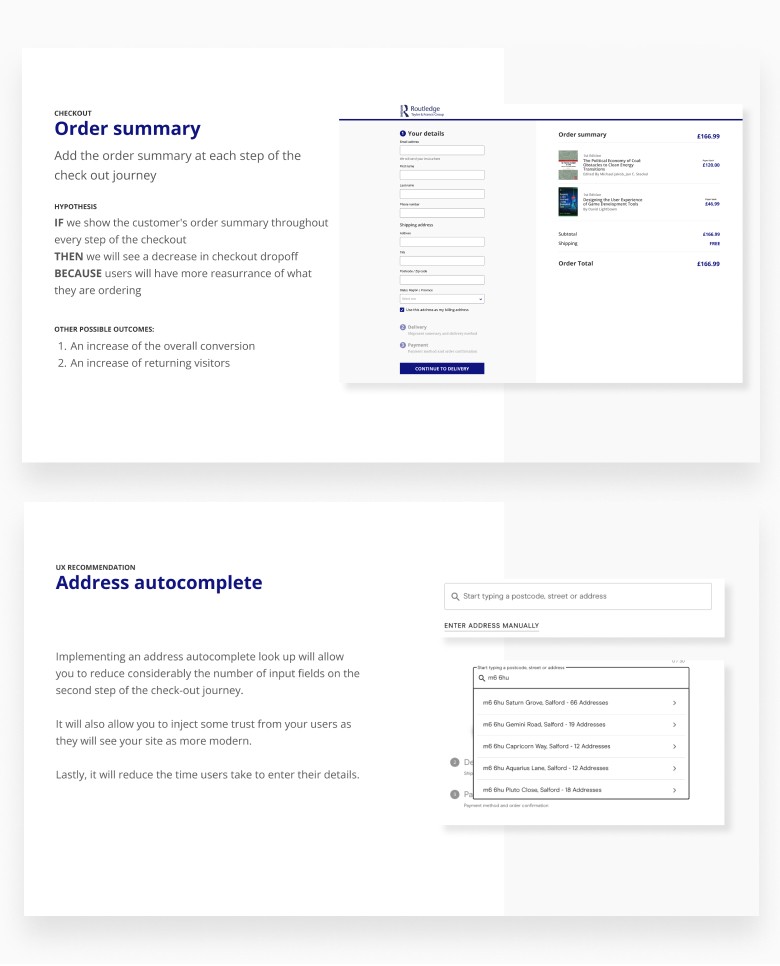
We expanded the dot-voted ideas into detailed hypotheses, including visuals of the proposed solutions and quick-win UX recommendations.

Next, we conducted a final workshop to prioritise these hypotheses and determine the most impactful solutions to pursue.

We fleshed out the dot-voted ideas into hypotheses with a visual of the solution and also gave them some quick-win UX recommendations.


We then took our hypothesis and ran our last workshop to prioritise the solutions. 

Examples of A/B test experiment using hypothesis design

Examples of A/B test experiment

using hypothesis design

Examples of A/B test experiment
using hypothesis design

Examples of A/B test experiment using hypothesis design

Prioritising the A/B tests

Our final step was to bring the team together to prioritise the developed ideas.

We collaborated with the Routledge team, including the product owner, lead developer, and head of digital, alongside our team to rank each test using an effort vs. value diagram.

The prioritised tests were then documented in a spreadsheet with scorecards agreed upon during the workshop.

Quantitative and qualitative research.

Quantitative and qualitative research.

Quantitative and qualitative research using google Analytics, content square and usability testing.

Quantitative and qualitative research using google analytics,
content square and usability testing.

The results

By adopting this process, we helped our client gain a deeper understanding of why their customers were dropping off and demonstrated the value of combining customer insights with quantitative data.

This approach resulted in a 3% increase in conversion rates and a significant reduction in cart abandonment, dropping from 88% to 70%. Additionally, we educated the team on creating a robust A/B testing backlog and delivered a year’s worth of testing experiments to support ongoing optimisation.


This process not only showcased the potential of data-driven optimisation but also fostered a strong partnership. As a result, they returned to us with additional projects, and we are now collaborating on redesigning their checkout journey.
Read more of my case studies

Read more
of my case studies

Read more
of my case studies

Get in touch

Get in touch

Get in touch

Get in touch